Showing posts with label review. Show all posts

Monday, February 1, 2016

Pet Girl of Sakurasou - A Review

                 "I realized... It wasn't that the days were boring. It was being just like everyone else."

Pet Girl of Sakurasou (or just Sakurasou as I will refer to it) is a surprising anime. What appears, at first, to be a rom-com slice of life series about a group of eccentrics, geniuses, and weirdos becomes an emotionally complex look at the impact talent and genius can have on average and gifted people alike. Our protagonist is Sorata Kanda, a high school boy of average intelligence, talent, and looks who is hard-working and kind-hearted. The former trait allowing him to be enrolled at a private high school for the arts named Suimei, the latter trait leads him to taking in every stray cat he sees and thus getting him expelled from his dormitory. He moves into Sakura Hall, an off-campus residence for "problem students" where he meets peers of his who are exceedingly talented, but also exceedingly strange. And while he cares deeply for his new friends, he is also deeply conflicted as a result of being around them.


“[You know...] with talented people... They draw people to themselves and without trying to, they tear them to shreds. The closer you are to them, the more viciously you’ll be torn apart.”

The main conflict of the series is an internal one Sorata, and another girl in his class Nanami suffer through; that no matter how hard they work, no matter how much of themselves they sacrifice to try and get ahead, the world is an unfair place and those with raw, natural talent will always come out ahead. It's played out time and time again for our two more average protagonists that failure is a very real and often unavoidable thing, and it's often juxtaposed against the successes and achievements of their talented peers. The show goes to great lengths to allow us to see the emotional toll these events take on our characters, and isn't afraid to make them lash out nastily or react in a very negative, but human, manner. Threaded into this central conflict are a handful of romances, often interrupted, derailed or complicated by the failures and successes of the characters. It comes together to created a detailed and emotional mosaic of life among those who are both very skilled, but still immature.


"Hey, what color do you want to be?"

But, the show does not let you down on your initial impression of the series as being a funny one, because it is very, very funny at times. The dialog is sharp, the characters very fully-formed, and the interactions they have are often the biggest highlights of the show. But, the real meat of the series lies in the (sometimes uncomfortably familiar) feelings of coping with conflict and failure, and where a person's true value lies. The show is also animated almost excruciatingly beautifully, with the smallest details left in, like seeing a character's pupil expand and contract as they become emotional. Overall, this is a powerful series that deals with the one thing modern fiction especially doesn't like to, which is the fact not everyone has some secret hidden talent that will just come bursting out if they work hard enough and believe in themselves. Sometimes, your best won't be good enough, but that doesn't matter as long as you do try, and are a good person to those around you. That's the real message of Sakurasou, and it's a message that will resonate long after all the other series about incredible, limitless heroes fade into the background.


Pet Girl of Sakurasou: 9/10



Monday, September 28, 2015

Your Lie in April: A Review


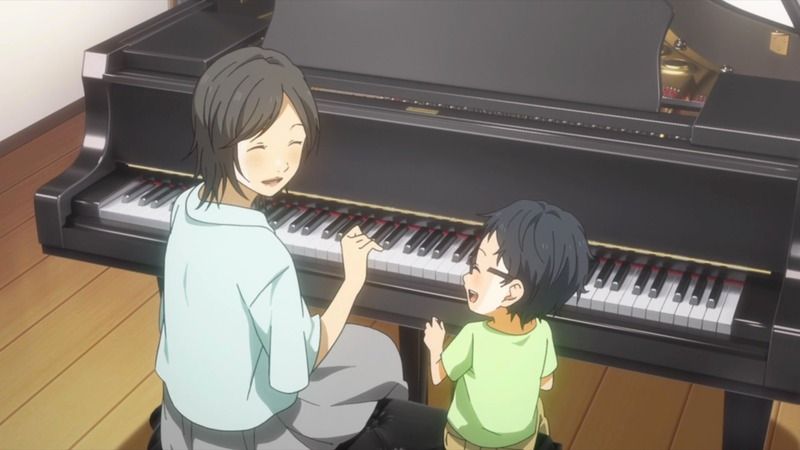
Your Lie in April is an anime about the turbulence of youth, first love, and the explosive power of music to channel our deepest emotions and project them onto others. The series focuses on 14-year old Kosei, a former piano prodigy who stopped playing after suffering a mental breakdown due to his mother's death. He finds himself unable to hear the notes he plays anymore, and his life has become dull and aimless as a result. This all changes when he meets Kaori, a spirited and wild violinist who motivates Kosei to play once again, with feeling. Alongside Kaori and his childhood friends Watari and Tsubaki, Kosei confronts the spectres haunting him, and discovers what really lies in the heart of a musician.


 First and foremost, the most noticeable thing about Your Lie in April is the astounding visuals present. Mixing traditional hand-drawn animation with CGI and watercolors, Your Lie in April might be the best looking anime of all time. The backgrounds are often detailed and gorgeous, heightening the mood of the scene without overwhelming it. And, the visuals are at their finest during the musical performances. Rather than show us what the audience would see with the naked eye, we are taken into an alternate reality of sorts, the inner mind-scape of the musician. The show crafts surreal, elegant, and often poignant sequences that convey the emotions and innermost thoughts of the musician while they play, springing to life the feelings they are attempting to share with the audience through their playing. Also significant is the use of color and pallet when relating to Kosei's journey in particular. At first, he sees the world in drab, monotone colors, washed out and blending together. But, Kaori's introduction brings a bright blast of color to the show, and the colors only deepen and become richer as the series progresses.


The music is, of course, incredible. The series has a wonderful original score, but the real highlights are the classic pieces performed by our musicians. From Beethoven to Chopin to Kreisler to Debussy, there is a wide variety of music present, and each one is used to punctuate a character arc, opening a window into our character's soul. From Kaori's free-wheeling with tempo on "Violin Sonata No.9, 1st Movement" to Kosei's emotional farewell to his mother via "Love's Sorrow" these familiar pieces become imbued with new meaning, and become transcendent. Combined with the unique visuals, each piece becomes a whole new thing, something you want to be able to live in yourself over and over again, to be able to feel that openly and grandly.


My only nitpick with Your Lie in April, and it's a small one, is the over-use use of slapstick humor. While levity is much needed to allow you to breathe in between the monstrously huge emotional performances, the use of physical humor (usually against a boy who had at one point suffered abuse) falls flat in comparison to the rest of the series' successes. But really, it's nothing that takes away from the show, but rather it stands out so much because the rest of the series is so good at everything it does. The voice acting is top notch, and the story is simple but told well and with wonderful, well-rounded characters. The show manages to balance rapturous joy with tragic heartbreak at every turn, making you invest more and more of yourself into the story and these characters. Even just thinking about moments in the series, or hearing that opening titles song can make all kinds of emotions rise to the surface and soar out of me. Kaori often asks in the show, "Will you forget me?" The answer, Your Lie in April, is never.  10/10


Monday, October 21, 2013

We Steal Secrets: A Review

We Steal Secrets is a documentary by Alex Gibney about Julian Assange, Chelsea (nee Bradley) Manning and WikiLeaks. Thought it was a very interesting film, which told the story of both people as well as the rise of the infamous website fairly well. It was much more focused on the aftermath of the leaks versus anything that came before, but in that way it almost is more effective because it plays on the nature of competing realities almost. What's reality to one person is not necessarily reality to another. And, these contrasting realities are the heart of the story. Assange, while smart and savvy, is also very petty and proud and selfish. While some might say he painted the target on himself to keep the rest of the people who made WikiLeaks under the radar, it seems to me more that he wanted the celebrity, he wanted to be the face and be the icon because it suited how he viewed himself best. He always saw himself as a Very Important Person who was both the rock star and the martyr. All the shit with his legal issues in Sweden, which if you listen to his followers make it seem like an international conspiracy to silence WikiLeaks forever, was nothing more than a man who refused to take an HIV test for two women who he had unprotected sex with, and got fed up with his attitude. He then allowed WikiLeaks followers to donate money to pay his bail and legal fees, all the while trying to keep his legal issues and WikiLeaks' issues tied together, thus making him almost a dual pariah. You see that he became this paranoid, secretive man who basically sabotaged his own creation and turned it into something he despised once. He was actively misinforming the public to protect his image of being the persecuted hero.
While Assange might be the more complex subject of the film, Manning is the most interesting. Here you have a person who is almost the polar opposite of Assange. While Julian Assange is almost master of his own reality, crafting and creating and editing as he goes along; Manning is a victim of realities. We see a person who from a very young age was under assault from the realities within and without that are created by us and forced upon us. Manning has an acute case of conscience and empathy, which doesn't fly well when working in Military Intelligence. Manning brings into her service a life of having to adapt and camouflage just to get by in day to day life, then finds herself faced with the stark realities of war. After having to stare long and hard at what is on the other side of the curtain, she decides that her reality must become everyone's. She can't handle this reality alone anymore. But, even though she feels morally vindicated for leaking all those hundreds of thousands of documents, she is torn by the implications. She feels for all the people who might be put in harm's way in the name of naked truth. But, most of all, it seems like she is in search of her true identity, her chosen reality, and maybe had hoped this would be a keystone in that journey.
Overall, I would give the film high marks despite getting a little bogged down in the mire of the Assange legal scandal, but I do praise the fact it reports on all sides of the issues, both in favor of and against the kind of leaks that took place. The film definitely has an opinion on the matter, but it is far closer to common sense than some documentaries in the past. Gibney has a knack for getting inside the heads of his subjects, and then using a wide array of visual styles to convey personalities and character traits and/or flaws to the audience. It is a strong piece of reporting, and from what I hear, not favored by WikiLeaks itself as much as The Fifth Estate which it had direct input in (take that as you will). And, if for no other reason, see this film because it tells Chelsea Manning's story, which all other takes on the WikiLeaks story fail to do. Manning's story is easily the most compelling and heartbreaking, maybe because she took all the risk, suffered all the consequences, but didn't get to become an icon for hackers and internet anarchists like Assange did for just being a middleman. Compelling stuff, at the end of the day, and a lot to think on.

Saturday, February 11, 2012

Naked: A Review


Watching Naked for the first time is quite like getting a tattoo someplace awkward. It can be aggravating, abrasive, noisy, and downright unpleasant during the duration. However, once you are finished, and you sit back and admire the work done, it can be an entirely satisfying and meaningful experience. As we follow the bitter and egotistical Johnny across London, we are witness to a man who is entirely unsatisfied with the world around him, and will stop and take the time to let you know about it. He seduces women, only to use their attraction as a form of punishment against them. He pontificates and preaches at great length about subjects that run the gamut from nihilism to transhumanism regardless of the interest of his audience. He is both a victim and a tormentor, mixing pain and pleasure to further levy control over those he views as weak and therefore beneath him. And he can never stop moving. Whether it's to escape the inevitable consequences of his actions, or because he is afraid to become stagnant, Johnny is always running. Any time it seems like Johnny might become stationary due to someone or something, he flees.


As I watch David Thewlis slip into the skin of this manic-depressive pariah, I can't help but admire the talent shown in both actor and director here. Thewlis and Leigh create in Johnny a Hamlet for Generation X. Disaffected, bitter, reckless, but eloquent and painfully aware of his own brilliance, Johnny can't help but try and provoke everyone he meets for a chance to display his believed superiority. He scoffs at people who work regular jobs, mocking the normalcy and routine of it all, while he pinballs his way around whatever locale he just happens to find himself in with no direction or intention. He chases women, and then grows tired of them almost immediately. He steals books, money, food, and time from anyone he can. This behavior, while cheeky at best and reckless at worst, is echoed darkly by Leigh's scenes with Jeremy, the sadistic and corrupt landlord that uses his money and position to assert power over those he controls. Kept apart for almost the entirety of the film, once Johnny and Jeremy finally cross paths, it is a scene where Johnny is left completely vulnerable for the first time in the film, as all of Johnny's intellectual superiority is rendered useless. Johnny may be clever enough to survive outside of society and in spite of it; but Jeremy is almost the personification of the late 80's early 90's "high" society, and scoffs in the face of any threat posed by other people. He knows he has control because he is simply more dangerous than anyone else in the room.


Mike Leigh has been praised for his work on this film, and rightfully so. He is able to capture the ever-changing attitude of Johnny with shots that alternate from manic panning back and forth of two adjacent rooms, close-ups on characters' faces as they attempt to mask their emotions, or long stark wide shots as Johnny espouses his apocalyptic beliefs to a lone night guard or as he walks aimlessly down a filthy, dark alley. The film uses hand-held cameras to provide a jarring, jittery movement to the film at times to mirror Johnny's emotion, usually his mania. The prominent grainy texture of the film also adds to the overall state of Johnny's life and experiences, creating an atmosphere of unpleasantness that our main character seems to wrap himself in like a shroud.

Overall, I found Naked to be harsh and aggravating at times, but in a good way. It was engaging and interesting and never let up on me for a moment. It almost seems like a companion piece to Happy-Go-Lucky, with Johnny's crushing nihilism and pessimism in the face of normalcy countered by Poppy's almost impossible optimism in the face of the very same normalcy, and how society often reacts in similar fashions to these wildly different deviations of behavior. Whatever statement Leigh might be making on society's acceptance of the rejection of such personalities is second to his ability to craft such extreme personalities and then insert them into situations of near-painful averageness and set them loose for maximum entertainment.  7/10

Summer Wars: A Review


Mamoru Hosoda's follow-up to the critically acclaimed The Girl Who Leapt Through Time, Summer Wars is a sci-fi tale set against the world of social networking and the effects it has on society. Quickly in the film we are introduced to the virtual world of OZ, a larger and more advanced version of online societies like Facebook and Second Life that incorporates shopping, finances, and even production and services as well as networking and gaming with virtual avatars. The system is so advanced and safe (through its "strongest in the world" security encryption) that even major civil systems like traffic lights and power are hooked into it and controlled remotely by employees using OZ. So, when a hyper-smart "learning" AI being developed for the US Military is "test drove" by dropping it into OZ, it quickly begins to hack and hijack accounts, leading to a worldwide crisis that could have devastating effects on both the virtual world and the real one. The story is told at a crisp pace, with imaginative action scenes inside the world of OZ balanced with the real world drama of a family coming to grips with tragedy and it's own image.


Our protagonist, Kenji, is the kind of kid you'd expect to be in OZ. Lonely and awkward, but brilliant, he spends most of his time in the film coming to grips with what it means to be part of something bigger than himself, and what it means to sacrifice for it. Coming from a home with mostly absentee parents, he is a stranger to family as anything other than a concept, and uses his role as a moderator and "code monkey" for OZ to substitute. It's only after he is dragged into a large, proud family by his classmate Natsuki (who is trying to pass off Kenji as her fiance to make her Grandmother proud), and he endure trials and tragedy alongside them does he fully embrace his abilities and faults to the benefit of all.


The AI, named "Love Machine" by its creator, is a compelling antagonist for Kenji and the denizens of OZ. It is literally a faceless entity without personality, designed to aggressively learn everything it is able to, and modify itself accordingly. In a world like OZ, it is able to battle, hack, manipulate, and wreak general chaos and havoc in both worlds. Kenji, who at first sees himself as only an avatar, has that stripped away by Love Machine when his account is the first to be hacked. Suddenly, the only identity Kenji is comfortable with has been stolen and twisted, and because of the events and experiences he has with Natsuki's family, does he discard the avatar and become the person. It becomes a virtual David vs. Goliath as Kenji pits his wits and anger and passion against a construct that sees it all as nothing more than a game.


The animation, as to be expected from studios like MadHouse, is top-notch. The design of the virtual world is quirky and imaginative, and full to the brim of unique little nooks and crannies. The art of the real world in the film is also quite good, with many long, wide shots of the family used at different emotional peaks of the film, at first setting up Kenji as an outsider, but as time goes by, showing the change in him and those around him. The attention to detail inSummer Wars is also excellent, especially in the scenes where Love Machine has literally become a giant composed of hundreds of millions of smaller avatars of the accounts it has stolen (see above picture for a small glimpse). Every scene of the film, though, was finely-crafted and I found rewarding to take in.


In the end, I feel Summer Wars had a much more interesting lesson than just warning against relying too heavily on technology, which is where it seemed to be going at first as the AI took over. But, as the chaos begins to clear, and people band together, we see the true message at the heart of the film. Family. Not just the physical one we live as part of, but also the virtual ones we create with games and social networking and instant messaging. The stronger our ties to those around us, the stronger our resolve to protect and enrich one another becomes. And, in the final scenes of the film, Summer Wars shows us that these principles apply to any community and family we belong to, not just our flesh and blood relatives. 9/10

Quickie Review: Man Bites Dog


I went into this film blissfully unaware of it's subject matter, plot, or any of the gory details. For this, I am very grateful, because the pure visceral shock I received upon first starting the film made the subsequent journey all the more enjoyable. I have never been, and most likely never will be, a fan of the slasher flick. But, despite Man Bites Dog containing a large amount of gore and death, I found myself enthralled rather than repelled by the film. The editing is sharp, often juxtaposing extremes to maximum comedic effect, which contributes more to the feeling of "strangeness" than the events depicted onscreen. There are cases where quick jump cuts of people being brutally murdered form almost a visual and sonic melody set against long, quiet, almost serene shots of their bodies being dumped into a quarry. The humor of the film was easily the best and most pleasant surprise, often making me laugh in spite of myself at extremely inappropriate moments, like people being shot. And I rarely laugh when people get shot. Like, 25% of the time. 40% tops. Or, running into a different killer with his own set of film crew and the light-hearted manner in which they dispose of the mirror reflections of themselves. Also, the running gag of sound guys being killed off like drummers in Spinal Tap was amusing. Especially when given an obituary in-film by the director referring to their deaths as "occupational hazards" and dedicating the film to their memory. Twice.


Despite the humor, the film itself is extremely dark in subject matter. Seeing the film crew slowly but steadily fall into a routine of not just observing murder, but participating in the grisly activities, is not only disturbing, but begs the question of responsibility of the artist. It reminded me of debates I have heard over journalists who visit war-torn or poor areas and whether or not they should intercede or just observe and report. While (obviously) in the film, the situation is more immediate and dire, the morality behind it draws the appropriate parallels about the responsibility of media in the face of tragedy and suffering. The film crew that act as Benoit's shadows and accomplices eventually get caught in the web of violence and meet the same end as those who trade in violence, and it feels both bittersweet and appropriate.  7.5/10

Wednesday, February 8, 2012

Chronicle: A Review


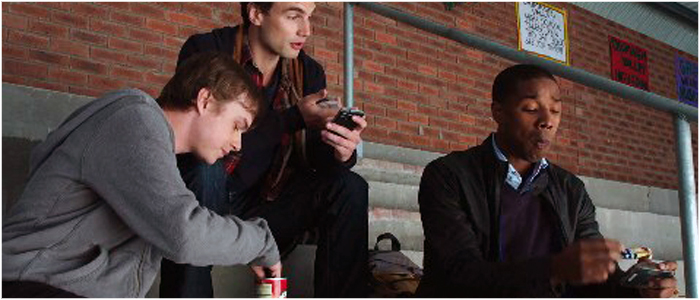
In Chronicle we are seeing the realized potential of the "found footage" style of film making.  In that the film itself uses the more intimate nature and setting of having our characters themselves film the events, but at the same time not feeling restricted to make the movie as "plausible" as possible.  We get to know our main characters very well in a short period of time by seeing them as they see each other, and then get to watch from their perspective as events change them forever.  Our protagonist is Andrew, a social outcast with an achingly familiar story of abuse and neglect.  He first buys a camera for the vague purpose of "filming everything" and quickly uses it to escape.  He welcomes the barrier it sets between him and the world, hoping it will protect him from his misery.  When his cousin, Matt, drags him (and the camera) to a party, he is brought along by Matt and another student, Steve, to film a cave that they found.  Inside, they discover a strange glowing formation that gives them super-powers.  We follow as the relationship between the three boys and their new powers changes them, but doesn't necessarily solve their problems for them.  We see that even an amazing gift can't heal the pain already deep inside, and that when someone feels they have nothing to lose, the consequences can be severe.


The primary reason Chronicle excels where other "found footage" movies have come up short is that at no point during the film is it never about the three boys.  Every scene, every moment of the film is about Andrew, Matt and Steve and how they are changing in relation to each other and the world around them.  We see Matt and Steve, already well-adjusted kids, using the power as an outlet for more fun, as a way to open all borders for them and hurdle any roadblocks.  Why not rent a cheap hotel room in Maui and just fly there?  But, for Andrew, the world has always been a hostile and painful place.  His mother is dying, and his father has turned to alcoholism in light of a work injury, trying to escape his own painful existence.  Andrew is abused by his father, graphically, right in front of us many times in the film.  Then Andrew is picked on at school, and made fearful for his own safety by neighborhood thugs.  There is literally nowhere Andrew is safe, and then he finds himself with the power to do anything he can think of.  But, even though he shares these powers with two peers, and for a while finds himself a new place to be, even that comes falling down on him when he loses control and sends a car into a lake accidentally.  Now, even his powers have rules imposed on them, limits to who he gets to be.  As time ticks by, we see Andrew question his relationships with everyone around him, retreating further and further into his own abilities, coming to believe he is a new breed of animal and not to be held in place by the laws of man.  By the time Matt or Steve realize anything is wrong, it is too late for Andrew.  We see the birth of a legitimate super-villain in the "real world" and we get to see it minute by minute, scene by scene.


Not to be overlooked is the editing of the film.  The real strength of the film is how well it is edited.  It combines dozens of sources into a linear, efficient narrative, from cell phone cams, to security cameras, to Police cruiser dashboard cams.  The film starts being shot solely from the perspective of Andrew's camera, he is our protagonist and who we are to identify with.  Then, a second source is introduced fairly early on in the love interest of one of the boys, but used sparingly at first, just to give us an outsider's perspective on the three main characters and how the world views them.  Then, as events begin to spiral out of control, more and more perspectives are added to the narrative flow, and we spend less time seeing things from Andrew's perspective, until we are not seeing anything from his POV during the climax.  The climax is shot entirely from outside sources, eyewitnesses to an event they can't understand, edited together masterfully to finally pull us, the audience, back from the three boys and let us see the bigger picture, and the scale of it all.  By doing this, they are able to really reinforce Andrew disconnecting from the world, and as a result, disconnecting from the audience.  He stops viewing himself as a human, and stops doing the things he did as a human, like filming his life, and spending time with his friends and family.  In addition to this, the editing maintains a brisk pace that keeps the audience involved in every scene, never dashing past moments, but also not lingering too long on any.  The balance works out well, as the shots on Andrew's camera tend to be long and breathe, while the shots on outsider's cameras are rapid and almost chaotic.

Chronicle is a great character-driven science fiction film that uses the "found footage" style to not only tell a story, but to enhance the arcs of characters being filmed.  A gem in the barren February/January cinematic landscape, to be sure.  8/10

Sunday, January 22, 2012

Attack the Block: A Review


Attack the Block is one of those rare, fresh-air kind of films you run into every so often. It took a novel concept, and a modest budget, and squeezed the absolute maximum out of it possible.  Attack the Block is set in south London, in an area known as the "ends" by our unlikely heroes, a gang of teenage thugs and muggers. We see our protagonists at work being unsavory right off the bat, mugging a terrified woman on her way home from work. It's not until aliens start crash landing all over the "block" and these kids are forced to defend themselves and others from harm do we see the true measure of their character. Many trials and tribulations occur, along with some genuinely clever scenes and plot twists, and we are allowed to see these kids for what they really are, kids. Kids with no purpose or role model, forced to deal with a harsh world on their own terms, suddenly thrust into a situation where they realize what pride, community, and sacrifice are all about.


Attack the Block does what few (recent) science fiction films have been able to do successfully, tie a story about space into a current social issue. In this case, we see the plight of the ghetto and it's inhabitants projected against monsters and interstellar fighting. We are shown that violence begets more violence, and that it is up to all of us to decide who we are and what we want to do with our lives. That living in the projects doesn't make you who you are, that heroes do in fact come from the least likely places. Attack the Block also does a surprisingly good job of building an arc for Moses, the leader of the teenage gang, that resonates with the viewer and gives you a feeling of closure when the film ends. Add that in with the effectiveness of the monsters, with their signature glowing fangs, and the excellent direction, and you have a sci-fi film that can rest comfortably in my top 5 of 2011.

Love Exposure: A Review


Love Exposure is the most Japanese movie ever made.

What that exactly means is a bit more complex and strange, just like the film itself. Love Exposure, at its base, is a romance. But, it's a romance distilled through the diverse and seemingly incompatable influences of Catholicism, upskirt photography, cross-dressing, cults/brainwashing, coreographed fighting, and graphic violence. Spread out over a seemingly immense 237 minutes, Love Exposure follows the trials and tribulations of Yu Honda, a quiet son of a Priest who seeks out a life of sin to please his father's obsession with them. Yu begins to train to snap photos of girl's panties, not because he finds pleasure in them, but because he wants to commit a sin even his hypocritical father finds reprehensable. Eventually these actions cause Yu to become entangled in the plots of a cult-like group called Zero Church, and fall in love with a man-hating girl named Yoko while he is dressed in drag. The myriad of places the movie eventually go are unexpected, yet surprisingly touching and disturbing in equal turns.


Love Exposure explores religion in a way Japanese films only seem capable of at times. The beauty and dangers of faith are displayed equally, and both serve to further the film's narrative. We see the church become a beacon of hope and light, of comfort and care for our protagonist, then suddenly turned into an instrument of hate and guilt because of the failings of men and women. We see people who use that sense of security to manipulate and harm, and we see people who would wear the mantle of faith to give forgiveness to those who may not deserve it, but because it is expected. We see Yu transform over time as he sees sin as something to collect to impress his distant father, who is also a Catholic Priest struggling with his own weaknesses. But, Yu is never anything other than earnestly trying to find love and acceptance, from his family and from the ideal woman he desperately seeks. But, his earnestness and naivety is turned against him by a damaged young girl who operates a cult in order to hold control over as many lives as possible. She claims to be interested in him, but her own horrible and violent past leads her to show her affections more in the vein of breaking him forever versus love and affection.


The film uses a very crude, yet immediately familiar symbol to show "true love" as it were. Yu is shown to never take any kind of pleasure from the photos he snaps, to the point he admits he has never had an erection. He is told he must "become erect from the heart" and continue his search. And, as to be expected, the presence, or lack thereof, of Yu's erections becomes part of the narrative. To his first one, to his inability to control himself around the one he loves, to the cult's attempts to brainwash it out of him, the states of Yu's arousal becomes a mise en scene for the mood of the character. Even reading it in text makes it seems vulgar and rediculous, which it is in part, but there's an unabashed energy to the film that makes it all seem to fit in. Not to mention the contrast we have between Yu, whose erections are presented as almost innocent and pure, and the abusive, dangerous men in the film that shape our female cast. And, of course, the most graphic scene in the film where one man's erection is removed with a incredibly violent, cringe-inducing moment. You'll know it when you see it. And it will add a very unsettling context to the way one of our characters views men.


When viewed as an whole, it becomes very difficult to classify Love Exposure. It's a tragedy, a romance, a drama, a comedy, even a bit of a horror story. It's a film about a small group of people with repressed, abnormal views on sex, love, religion, and society. It's a film about how love shatters preconceptions, but can also reinforce stereotypes. How belonging to something larger than yourself can divide as often as it unites. And, how sometimes a boner can be the most pure sign of love there can be. There's comedy, depression, cross-dressing, weird insular cultures, and even a rampaging swordsman. So, in other words, the most Japanese film ever made.

Love Exposure is a modern classic, and I would consider it a must-watch for all cinema fans. Be prepared for a long journey, but one that is entirely worth taking. 10/10